Pro Rata Calculator: Part-Time Salary and Take-Home Pay
Job adverts love the phrase “£30,000 pro rata”, and it rarely means what it seems. That figure is the full-time salary, so a three-day role pays far less, and the payslip after tax is different again. Term-time contracts add another layer, because the weeks you are paid are not the same as the weeks you work.
Pro Rata Salary Calculator
Part-time or term-time pay from a full-time salary, with take-home pay, holiday and an hourly rate check for 2026/27.
1. The full-time job
2. Your working pattern
Full-time holiday means the yearly leave a full-time colleague gets, including bank holidays. 28 days is the legal minimum. Many councils and schools give 30 to 36, so check your contract.
3. Deductions for take-home pay
Pro rata salary
a year before tax
Gross per month
Share of full-time pay
Hourly rate
Take-home pay: full time vs your pattern
| Per year | Full time | Your pay |
|---|
2026/27 rates on a standard 1257L or S1257L code. Pension is a workplace pension on the whole salary taken before tax (net pay). Hourly rate uses 52.14 weeks a year. Term-time pay uses the paid-weeks method most councils follow, but your employer’s formula decides your actual salary.
This pro rata calculator turns any full-time salary into your real pay by hours, days or FTE, including term-time contracts. It shows take-home pay next to the full-time figure, your holiday entitlement and a minimum wage check, with every number based on 2026/27 tax and National Insurance rates.
How to use the pro rata calculator
- Enter the full-time salary from the job advert or your contract, per year or per month, and the hours in a full-time week. Most employers use 37.5, the NHS uses 37.5 and many councils use 37.
- Choose how your pattern is set out. Hours suits most contracts, days works when every day is the same length, and % of full time matches contracts written as 0.6 or 0.8 FTE.
- Switch the contract to term-time only if you are paid for school weeks, then enter the weeks you work and the holiday a full-time colleague gets.
- Add your pension and student loan, then calculate to see your pro rata salary, take-home pay, holiday and hourly rate.
How to work out pro rata salary
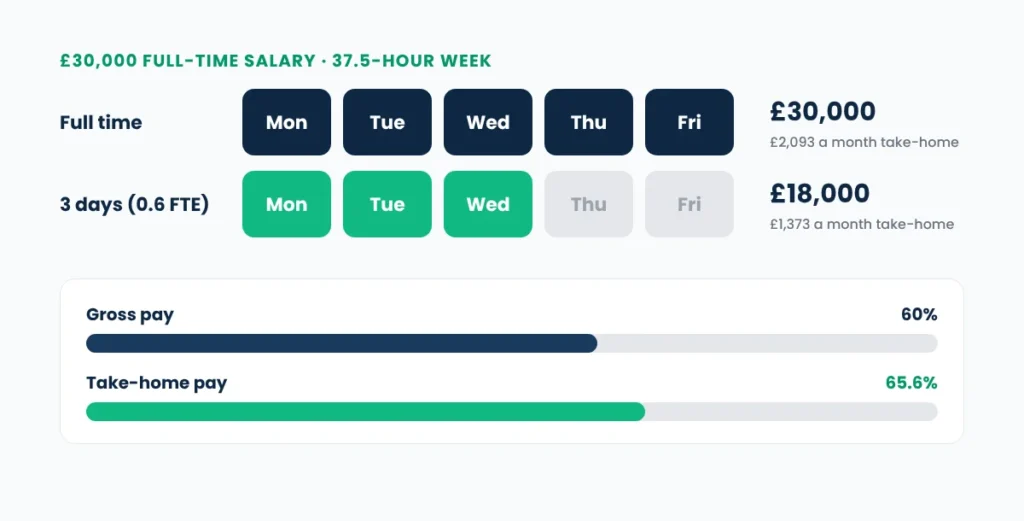
Divide your weekly hours by the full-time hours, then multiply the full-time salary by the result. On a £30,000 salary with a 37.5-hour full-time week, someone working 22.5 hours does 60% of the hours, so their pro rata salary is £30,000 × 0.6 = £18,000 a year, or £1,500 a month before tax.
Hours, days or FTE: which one to use
All three give the same answer when every working day is the same length. They split apart when they are not. Three long days of 10 hours are 30 hours, which is 80% of a 37.5-hour week, not the 60% that “3 days out of 5” suggests. Contracts in the public sector often state an FTE figure such as 0.8, which is simply the hours fraction written as a decimal. The calculator accepts all three, so it works as a part time salary calculator however your contract is written.
Pro rata monthly salary
The same fraction applies to a monthly figure. A full-time salary of £2,500 a month at 0.6 FTE gives £1,500 a month. Because salaried staff are paid the same amount each month whatever the number of working days, the monthly figure is simply the yearly pro rata salary divided by 12.
The table shows pro rata pay for common salaries on a five-day full-time week.
Pro rata salary quick reference
| Full-time salary | 4 days80% | 3 days60% | 2.5 days50% | 2 days40% |
|---|---|---|---|---|
| £20,000 | £16,000 | £12,000 | £10,000 | £8,000 |
| £25,000 | £20,000 | £15,000 | £12,500 | £10,000 |
| £30,000 | £24,000 | £18,000 | £15,000 | £12,000 |
| £35,000 | £28,000 | £21,000 | £17,500 | £14,000 |
| £40,000 | £32,000 | £24,000 | £20,000 | £16,000 |
| £45,000 | £36,000 | £27,000 | £22,500 | £18,000 |
| £50,000 | £40,000 | £30,000 | £25,000 | £20,000 |
| £60,000 | £48,000 | £36,000 | £30,000 | £24,000 |
Yearly pay before tax. 3 days is also 22.5 hours of a 37.5-hour week, and 2.5 days is 18.75 hours.
What “pro rata” means in a job advert
An advert that says “£30,000 pro rata” is quoting the full-time equivalent salary. You get your share of it based on the hours in the contract. It lets employers advertise one rate for full-time and part-time staff, and it is why the number on the advert can be much higher than your actual pay.
What does 37.5 hours pro rata mean?
It tells you the salary on the advert is for a 37.5-hour week. If the role is 15 hours a week, you are paid 15 ÷ 37.5, or 40%, of the advertised salary. The same wording with 37 or 40 hours changes the fraction, so always check which full-time week the employer uses.
What is £80,000 pro rata?
It is £80,000 for full-time hours. On three days out of five you would earn £48,000 a year, which leaves about £3,173 a month after Income Tax and National Insurance in England, compared with £4,746 a month full time.
Checking an advert with the pro rata calculator
Two adverts can show the same pay and still be very different jobs. A part-time role paying £24,000 for 30 hours works out at about £15.34 an hour, while £24,000 for 22.5 hours is about £20.46 an hour. Entering the full-time salary and hours for each role shows which one really pays more for your time.
Why part-time take-home pay falls less than your hours
Income Tax and National Insurance thresholds are fixed amounts, so they do not shrink when you work fewer hours. The £12,570 Personal Allowance and the NI threshold cover a bigger share of a smaller salary, which means a part-time worker keeps more of every pound than a full-time colleague on the same rate.
Take-home pay on a 3-day week, 2026/27
| Full-time salary | Full timeper month | 3 days (60%)per month | Take-home kept |
|---|---|---|---|
| £25,000 | £1,793.30 | £1,193.30 | 66.5% |
| £30,000 | £2,093.30 | £1,373.30 | 65.6% |
| £35,000 | £2,393.30 | £1,553.30 | 64.9% |
| £40,000 | £2,693.30 | £1,733.30 | 64.4% |
| £50,000 | £3,293.30 | £2,093.30 | 63.6% |
| £60,000 | £3,779.78 | £2,453.30 | 64.9% |
England, Wales and Northern Ireland, after Income Tax and National Insurance, with no pension or student loan. Every row keeps more than 60% of the full-time take-home.
A four-day week on £30,000 shows the effect clearly. Pay drops by 20%, but take-home falls from £2,093.30 to £1,733.30 a month, so you keep 82.8% of it. To see a full breakdown at your own salary, the take home pay calculator works from any figure.
Deductions that do not scale with your hours
- Student loans. Repayments only start above a yearly threshold, £29,385 for Plan 2 in 2026/27. A £35,000 salary repays about £505 a year, but the same job at 0.6 FTE pays £21,000 and repays nothing.
- Workplace pensions. Employers only have to enrol you automatically if you earn over £10,000 a year, and many schemes count earnings above £6,240. A small part-time salary may fall below both, although you can still ask to join.
- Second jobs. If you combine two part-time roles, your allowance usually sits with one of them, and the other is taxed on a BR code. The second job tax calculator shows how that splits.
Term-time pro rata pay
Term-time contracts are reduced twice. Once for the hours you work each week, and again for the weeks you are paid. The catch is that paid weeks are more than the weeks you work, because your salary also includes the holiday a full-time worker would take, spread over the year.
Most councils and schools use this formula. Paid weeks equal weeks worked × 52.14 ÷ (52.14 − full-time holiday in weeks), where holiday includes bank holidays. For 39 weeks with 28 days of full-time holiday, that gives 43.7 paid weeks, or 83.8% of the full-year salary.
Term-time paid weeks and salary
| Weeks worked | Full-time holiday | Paid weeks | Share of full-year pay | £25,000 FTE, full hours |
|---|---|---|---|---|
| 38 weeks | 28 days | 42.6 | 81.6% | £20,411 |
| 39 weeks | 28 days | 43.7 | 83.8% | £20,948 |
| 39 weeks | 32 days | 44.5 | 85.3% | £21,315 |
| 39 weeks | 36 days | 45.2 | 86.8% | £21,694 |
| 40 weeks | 32 days | 45.6 | 87.4% | £21,861 |
Paid weeks = weeks worked × 52.14 ÷ (52.14 − full-time holiday in weeks). Holiday includes bank holidays. Your council or school may use its own formula.
So a role advertised at £30,000 for 22.5 hours over 39 weeks pays about £15,083 a year, or £1,256.90 a month. Multiplying by 39 ÷ 52 alone would give £13,463, which is £1,620 too little. If your salary looks close to that lower figure, ask payroll how holiday has been included. The term-time option in the pro rata calculator above uses the paid-weeks method.
Pro rata pay for school support staff
Teaching assistants and other school support staff on council contracts are usually paid this way, with the leave figure taken from their own service length. A 37-hour role on a £20,000 FTE salary, working 39 weeks with 36 days of full-time leave, is paid about 45.25 weeks and £17,355 a year. Councils can use a different formula, so your contract and payslip are the final word.
Pro rata holiday entitlement
Almost every worker is entitled to 5.6 weeks of paid holiday a year. For part-time staff on regular hours, that means 5.6 times the days or hours you normally work in a week, up to a cap of 28 days. GOV.UK sets out the full rules.
Statutory holiday for part-time workers
| Days worked a week | Minimum holiday a year | In hours on 7.5-hour days |
|---|---|---|
| 1 day | 5.6 days | 42 hours |
| 2 days | 11.2 days | 84 hours |
| 3 days | 16.8 days | 126 hours |
| 4 days | 22.4 days | 168 hours |
| 5 days | 28.0 days | 210 hours |
| 6 days | 28 days (cap) | 210 hours |
5.6 weeks of your normal working week, capped at 28 days. Bank holidays can count towards it. Part-year and irregular-hours workers instead build up 12.07% of the hours they work.
Bank holidays for part-time workers
Bank holidays do not have to be given as extra leave, and many employers count them within the 5.6 weeks. Most employers give part-time staff a pro rata share of the year’s bank holidays rather than only the ones that fall on their working days, so the total stays fair whichever days you work. Someone who never works Mondays still gets their full 5.6 weeks.
Holiday for term-time and irregular-hours workers
Since April 2024, part-year and irregular-hours workers can build up holiday at 12.07% of the hours worked in each pay period. For most term-time staff, holiday pay is already built into the paid weeks above, which is why their salary is paid in 12 equal parts even during the summer break.
Pro rata pay in the NHS
NHS Agenda for Change pay is based on a 37.5-hour week, so a part-time salary is the band pay multiplied by your hours ÷ 37.5. Unsocial hours payments are worked out on the hours you actually do. The NHS take home pay calculator covers bands, enhancements and the NHS Pension, and the NHS maternity pay calculator helps if you plan to return on fewer hours after maternity leave.
Starting or leaving partway through a month
Pro rata also applies to a part month. Your contract or payroll policy decides which of three common methods is used. On a £24,000 salary, which is £2,000 a month, someone starting on the 17th of a 30-day month with 10 of 22 working days left would get the following.
- Calendar days. 14 ÷ 30 of a month, which is £933.33.
- Working days in the month. 10 ÷ 22 of a month, which is £909.09.
- Working days in a year. £24,000 ÷ 260 × 10, which is £923.08.
The difference is small, but check the method on your contract if the first or last payslip looks wrong.
Pro rata pay and the minimum wage
Pro rata pay must still meet the minimum wage for every hour you work. From 1 April 2026 the National Living Wage is £12.71 an hour for workers aged 21 and over, £10.85 for 18 to 20 year olds and £8.00 for under 18s and apprentices. GOV.UK lists the current rates.
Your hourly rate is the full-time salary ÷ 52.14 weeks ÷ full-time hours, and it is the same whether you work full time or part time. If you are paid by the hour rather than a salary, the hourly wage calculator turns your rate into yearly and monthly take-home pay. Part-time workers also have the right not to be treated less favourably than full-time colleagues on pay, holiday and pensions, as GOV.UK explains.
Frequently Asked Questions
Sources for the rates used
- GOV.UK: Rates and thresholds for employers 2026 to 2027
- GOV.UK: Holiday entitlement
- GOV.UK: National Minimum Wage and National Living Wage rates
- GOV.UK: Income Tax in Scotland
- GOV.UK: Workplace pensions
Checked against the published 2026/27 rates. See how we calculate for the method behind our tools.