UK Take Home Pay Calculator
Find out how much salary you will actually receive after tax and deductions using the UK Take Home Pay Calculator. Get an accurate gross-to-net salary breakdown including Income Tax, National Insurance, PAYE, pension contributions, and other adjustments.
Calculate Your Take Home Pay After Tax
Options
Your results
| Breakdown | Annual | Monthly | Weekly | Daily |
|---|
Bonus details
Normal pay period
Bonus pay period +bonus
Overtime details
Without overtime
With overtime
Year-on-year comparison
HOW IT WORKS
Your Take Home Pay in 3 Simple Steps
Using the UK salary calculator is straightforward. You’ll need to select your tax year, adjust the number of days and hours you work, and input your gross salary. Each of these steps is crucial for an accurate take home pay calculation. Simply follow these three steps in Take Home Pay Calculator:
Enter your Gross Salary
Type your gross salary (amount before any deductions) — Select whether this is your annual, monthly, weekly or hourly rate. Use the figure on your contract or payslip.
Add your details
Select your tax region and tax year. Optionally add pension, student loan, or other deductions.
See your results
Instantly see your results inside the take home pay calculator broken down by year, month, week, and day. Download as PDF.
Whether you work in London, England, Scotland, Wales, or Northern Ireland, your take-home pay can vary depending on tax rules and deductions. This online take home pay calculator helps you estimate your salary after tax based on your earnings and location. Last Updated: April 2026 Tax rates are reviewed every April. Next update: April 2027.
What Does Your Take Home Pay Actually Mean?
Your take-home pay (also known as your net income) is the actual amount of money that lands in your bank account on payday. While your employment contract states your gross annual salary, that top-line figure doesn’t reflect your real spending power.
Think of your gross salary as the starting point; what remains after HMRC-mandated deductions is calculated using a take home pay calculator and your personal workplace adjustments are processed. Understanding the difference between these two figures is the first step toward smart financial planning and budgeting.
Gross Salary vs Net Salary
|
Trem |
Definition |
|
Gross Salary |
Total earnings before any deductions, the number on your contract |
|
Net Salary |
Money in your bank account after Income Tax, NI, and pension are removed |
|
Personal Allowance |
First £12,570 you earn each year is completely tax-free (2026/27) |
|
Tax Code |
HMRC code that tells how much tax is deducted (default: 1257L) |
TAX GUIDE
How is Your UK Take-Home Pay Calculated?
Your UK take-home pay is calculated by starting with your gross salary and then applying the deductions required by HMRC. These deductions can include Income Tax, National Insurance, student loan repayments, and workplace pension contributions. The exact amount you take home depends on your earnings, tax code, and personal circumstances. Understanding how each deduction works can help you better interpret your payslip and estimate your net income more accurately.
Income Tax & Personal Allowance
You pay zero Income Tax on the first £12,570 you earn (Personal Allowance). Earnings above this threshold are taxed progressively in bands — only the slice above each threshold is taxed at the higher rate, not your entire income.
|
Tax Band |
Rate |
|
£0 – £12,570 |
0% (Personal Allowance) |
|
£12,571 – £50,270 |
20% (Basic Rate) |
|
£50,271 – £125,140 |
40% (Higher Rate) |
|
Over £125,140 |
45% (Additional Rate) |
Income Tax Bands — England, Wales & Northern Ireland (2026/27)
Scotland — Different Tax Bands Apply
Scottish taxpayers pay Income Tax under six separate bands (Starter 19%, Scottish Basic 20%, Intermediate 21%, Higher 42%, Advanced 45%, Top 48%). Select ‘Scotland’ in the take home pay calculator for an accurate figure.
National Insurance (NI) Contributions
Employees pay Class 1 National Insurance (NI) at 8% on earnings between £12,570 and £50,270, and 2% on anything above. Your employer pays an additional 15% on earnings above £5,000. This does not come out of your take-home pay.
|
NI Band |
Weekly Earnings |
Employee Rate |
|
Below PT |
Under £242/week |
0% |
|
Standard Rate |
£242 – £967/week |
8% |
|
Upper Rate |
Over £967/week |
2% |
PAYE & Tax Codes
PAYE (Pay As You Earn) is the system HMRC uses to collect tax directly from your employer before payday. Your tax code (e.g., 1257L) tells your employer exactly how much tax to deduct each month. If your code is wrong, you could be overpaying or underpaying tax without realising it.
Student Loan Repayments
Repayments are automatic once your salary crosses your plan’s threshold. The rate applies only to earnings above the threshold — not your entire salary.
|
Loan Plan |
Repayment Threshold |
Rate |
|
Plan 1 |
£26,900/year |
9% above threshold |
|
Plan 2 |
£29,385/year |
9% above threshold |
|
Plan 4 (Scotland) |
£33,795/year |
9% above threshold |
|
Plan 5 |
£25,000/year |
9% above threshold |
|
Postgraduate |
£21,000/year |
6% above threshold |
Workplace Pension & Salary Sacrifice
In the UK, most employees are automatically enrolled into a workplace pension scheme, with a standard minimum contribution of 5% from your salary and 3% from your employer.
Opting for a Salary Sacrifice arrangement allows you to legally reduce your gross salary before Income Tax and National Insurance are calculated. This smart financial choice means you instantly save on taxes while simultaneously growing your retirement pot. Tracking these pension adjustments inside a precise take home pay calculator ensures your estimated net take-home monthly pay remains perfectly accurate.
Interactive UK Take home pay chart
Visualise your complete salary breakdown with our interactive Gross Income, Take-Home Pay, and Taxable Income chart. See at a glance how your final net salary is calculated across popular UK annual salary bands, based on the standard 2026/27 tax codes and current personal allowance thresholds.
This detailed take home pay calculator visual breakdown shows Income Tax, NI, and pension deductions for 2026/27. Figures are illustrative — for specific details including tax code, student loan, and pension, net to gross calculator uk a full breakdown is required.
Smart Tips for Maximising Your Take-Home Pay Legally
These HMRC-compliant strategies can meaningfully increase what lands in your bank account each month.
1. Check and Correct Your Tax Code
HMRC issues the wrong tax code more often than you’d think. If your code is incorrect, you may be overpaying tax every month. Check via the HMRC app or call +44 135 535 9022 to request a correction and trigger a refund.
2. Use Salary Sacrifice Schemes
Pension salary sacrifice, Cycle to Work, and electric car leasing schemes let you swap part of your gross salary for non-cash benefits, reducing your taxable income and lowering your National Insurance liability.
3. Understand Taxable
Company cars, private health insurance, and employer-paid fuel are classed as Benefits in Kind and are added to your taxable income. Factor these into the take home pay calculator to avoid a surprise tax bill at year end.
How much do you pay in taxes?
In the UK, Income Tax is charged using a progressive bracket system, meaning you only pay tax on earnings that sit above your standard Personal Allowance threshold. Each income band is taxed completely independently of the others.
For example, moving into the Higher Rate band does not mean your entire salary is suddenly taxed at 40%. Instead, only the specific “slice” of income that falls above £50,270 is subject to the higher rate, while your lower earnings remain protected under the 0% and 20% tax rates.
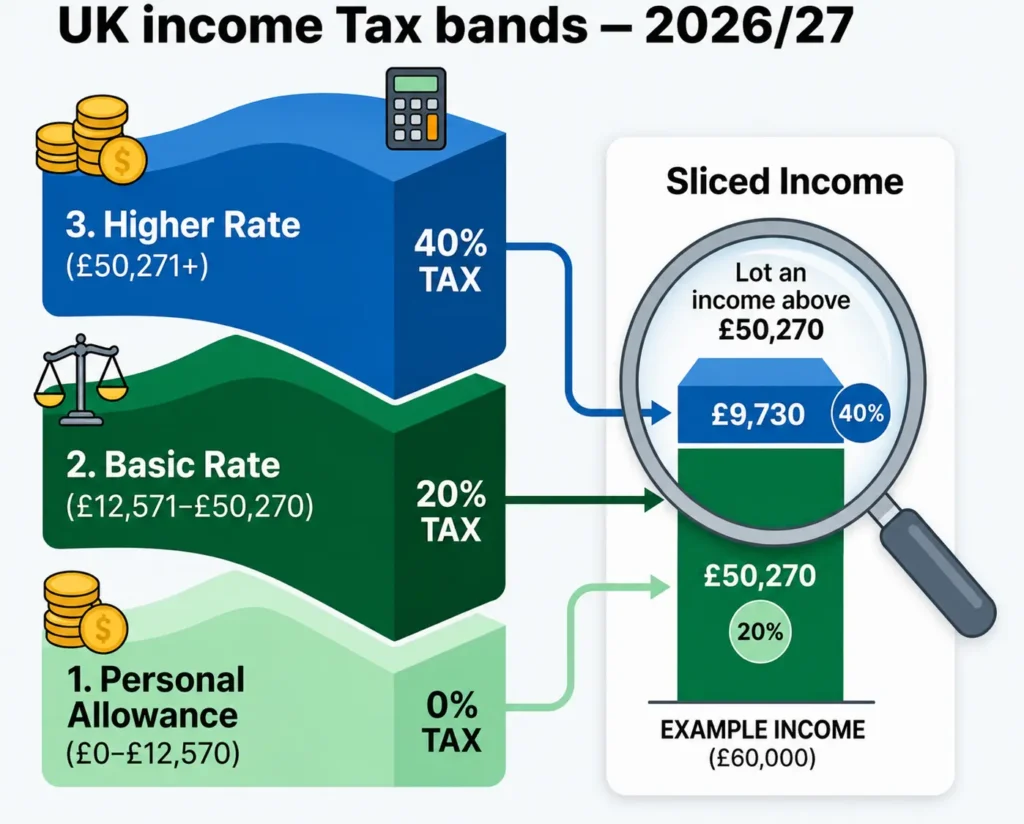
Similar to trusted tools like Martin Lewis’s MoneySavingExpert (MSE) Income Tax Calculator, our UK Take Home Pay Calculator is designed to give you a clear estimate of your after-tax salary by considering factors such as gross income, tax deductions, National Insurance, and other salary adjustments.
UK Net Salary Table At a Glance
This quick-reference table provides an instant overview of your estimated net pay across popular UK annual salary bands for the 2026/27 tax year. Based on the standard 1257L tax code, it breaks down exactly how much you take home after Income Tax and National Insurance adjustments. Use these benchmarks to quickly verify your earnings or compare different salary brackets at a single glance.
Here is Gross to net income table chart with the most popular average salaries and calculated take home pay, actual percentage paid on taxes.
|
Gross Income (Yearly) |
Take-Home Pay (Yearly) |
Take-Home Pay (Monthly) |
Effective Deduction Rate |
|
£15,000 |
£14,320 |
£1,193 |
4.53% |
|
£20,000 |
£17,920 |
£1,493 |
10.4% |
|
£25,000 |
£21,520 |
£1,793 |
13.92% |
|
£30,000 |
£25,120 |
£2,093 |
16.26% |
|
£40,000 |
£32,320 |
£2,693 |
19.2% |
|
£50,000 |
£39,520 |
£3,293 |
20.96% |
|
£60,000 |
£45,357 |
£3,780 |
24.40% |
|
£75,000 |
£54,057 |
£4,505 |
27.92% |
|
£100,000 |
£68,557 |
£5,713 |
31.44% |
Built for Your Situation
Specialist UK Pay Calculators
Depending on your profession or employment type, your tax situation may require a specialised take home pay calculator. Use our dedicated tools below to get an exact estimate:
NHS Take-Home Pay Calculator
Tailored for healthcare professionals, this tool covers all Agenda for Change pay bands (1–9), NHS pension contribution adjustments, and unsocial hours enhancements.
→ NHS Calculator
Teacher Pay Calculator
Accurately calculates take-home pay for educators, factoring in the Main Pay Scale, Upper Pay Scale, and the latest Teachers’ Pension Scheme (TPS) contribution rates.
→ Teacher Calculator
Contractor Pay Calculator (Inside & Outside IR35)
Essential for freelancers and contractors to compare Limited Company dividend extraction options against Umbrella Company PAYE structures, ensuring full IR35 compliance.
→ Contractor Calculator
Self-Employed & Sole Trader Calculator
Perfect for business owners filing a Self Assessment. It handles Class 2 and Class 4 National Insurance, as well as allowable business expense deductions to find your true take-home profit.
→ Self-Employed Calculator
Looking to Get on the Property Ladder?
If you are calculating your take-home pay to plan for a mortgage, you are in the right place. Many lenders assess affordability primarily based on your net monthly income rather than just your gross salary. Use our free mortgage planning tool alongside the take home pay calculator to see how much you can realistically borrow based on your real take-home pay.