Overtime Calculator: Work Out Your Overtime Pay After Tax
You worked the extra shifts, did the sums at time and a half, and then the payslip arrived with far less than you expected. Overtime is rarely worth what the hourly rate suggests, because tax, National Insurance and sometimes a student loan take their share first, and a big month can lose even more for a while.
Overtime Calculator
Overtime pay at any rate, with the tax, NI and student loan it costs and what you actually keep in 2026/27.
1. Your normal pay
2. Your overtime
Overtime at rate 1
Overtime at rate 2
3. Deductions
Overtime rate
Gross overtime
You keep
Kept from each £1
after all deductions
Where your overtime goes
| On the overtime |
|---|
Your payslip
| Normal | With overtime |
|---|
2026/27 rates on a 1257L or S1257L code. Hourly rate from a salary uses 52.14 weeks a year. A one-off payslip is worked out with that pay period’s own thresholds, which is what payroll does for National Insurance and student loans. Pension is a net pay workplace pension.
This overtime calculator works out your overtime rate and gross overtime pay at any multiplier, then shows what you keep on this payslip and by the end of the tax year. It covers two rates such as weekday and Sunday overtime, hours and minutes, Scottish tax, pensions and student loans, with every figure based on 2026/27 rates.
How to use the overtime calculator
- Enter your basic pay as a yearly salary or an hourly rate, plus your contracted hours a week. The calculator turns a salary into an hourly rate for you.
- Choose the overtime rate and enter the hours and minutes. Add a second rate if some of the hours were paid differently, for example time and a half on weekdays and double time on a Sunday or bank holiday.
- Pick “On one payslip” for overtime in a single month or week, or “Every payslip” if you do the same overtime all year.
- Add your pension and student loan, and tick the pension box if your employer takes pension contributions from overtime too.
How to work out overtime pay
Multiply your normal hourly rate by the overtime multiplier, then by the hours you worked. At £16 an hour, 10 hours at time and a half is £16 × 1.5 × 10 = £240 before tax. Minutes count too, so 7 hours 30 minutes is 7.5 hours and 7 hours 45 minutes is 7.75 hours.
Working out your hourly rate from a salary
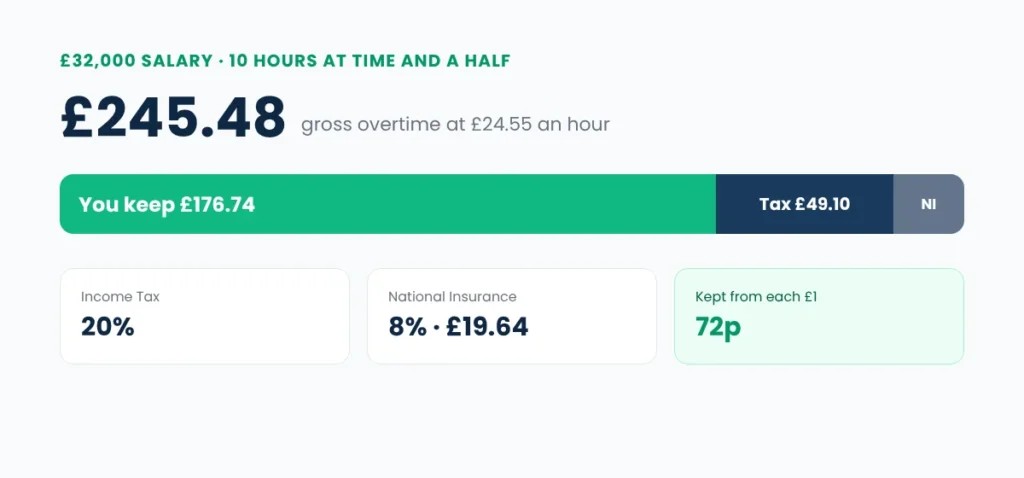
If you are paid a salary, divide it by the weeks in a year and then by your weekly hours. A £32,000 salary on a 37.5-hour week gives £32,000 ÷ 52.14 ÷ 37.5 = £16.37 an hour, so time and a half is £24.55. Some employers divide by 52 instead, which gives a slightly higher rate, and your contract or handbook says which one applies.
Common overtime rates
Time and a half is the most common rate in the UK. Double time is usually kept for Sundays, bank holidays or call-outs, while time and a quarter and time and a third appear in some public sector and union agreements. Plenty of employers pay plain time, and some pay nothing extra at all for salaried staff.
Overtime rates by hourly pay
| Normal hourly rate | Time and a quarter1.25x | Time and a third1.33x | Time and a half1.5x | Double time2x |
|---|---|---|---|---|
| £12.71 | £15.89 | £16.95 | £19.07 | £25.42 |
| £14.00 | £17.50 | £18.67 | £21.00 | £28.00 |
| £15.00 | £18.75 | £20.00 | £22.50 | £30.00 |
| £16.00 | £20.00 | £21.33 | £24.00 | £32.00 |
| £18.00 | £22.50 | £24.00 | £27.00 | £36.00 |
| £20.00 | £25.00 | £26.67 | £30.00 | £40.00 |
| £25.00 | £31.25 | £33.33 | £37.50 | £50.00 |
£12.71 is the National Living Wage for workers aged 21 and over from April 2026.
Is overtime taxed more?
No. There is no separate tax rate for overtime. It is added to your pay and taxed at the same rate as the top slice of your normal earnings, so a basic rate taxpayer pays 20% Income Tax and 8% National Insurance on it, and a higher rate taxpayer pays 40% and 2%.
Why your overtime payslip can look taxed more
Payroll works out tax one pay period at a time. A big month of overtime can push that month’s pay over the monthly higher rate limit even when your yearly pay stays under £50,270, so part of it is taxed at 40% on that payslip. On a cumulative code such as 1257L, the extra comes back over the next few payslips. On an emergency code ending in W1, M1 or X, it waits until after the tax year ends.
Checking a big overtime month with the overtime calculator
Take a £48,000 salary with 30 hours of overtime in one month at time and a half. That is £1,104.65 extra, and the payslip can take up to £403.88 in Income Tax on it. Across the whole year the real cost is £220.93, because £49,105 is still in the basic rate band. Choosing “On one payslip” in the calculator shows both figures.
National Insurance and student loans on overtime
National Insurance is also worked out per pay period, but it does not get balanced at the end of the year. Monthly pay above £4,189 pays 2% instead of 8% on the extra, so a big overtime month can cost slightly less NI than the same overtime spread out. Student loan repayments work per period too, so a one-off month can trigger a repayment even if your yearly pay is below the threshold. You can ask the Student Loans Company for a refund after the tax year ends.
How much of your overtime you keep
How much you keep depends on which band the extra pay falls into. Most people keep between 58p and 72p of every pound, but the figure drops sharply in a few places.
What you keep from £100 of overtime, 2026/27
| Your yearly pay before overtime | Income Tax | National Insurance | You keep |
|---|---|---|---|
| Under £12,570 | £0 | £0 | £100 |
| £12,570 to £50,270 | £20 | £8 | £72 |
| £12,570 to £50,270 with Plan 2 loan* | £20 | £8 + £9 loan | £63 |
| £50,270 to £100,000 | £40 | £2 | £58 |
| £100,000 to £125,140 | £60 | £2 | £38 |
| Over £125,140 | £45 | £2 | £53 |
| Scotland, £43,662 to £75,000 | £42 | £8 or £2 | £50 to £56 |
England, Wales and Northern Ireland unless stated, with no pension. *Student loan applies once pay is above the £29,385 Plan 2 threshold. In Scotland NI drops from 8% to 2% at £50,270, so the 42% band costs 50p or 44p in every £1.
Overtime that crosses a threshold
- £50,270. Overtime above this point is taxed at 40% in England, Wales and Northern Ireland. In Scotland the 42% band starts lower, at £43,662.
- £60,000. If you or your partner get Child Benefit, the High Income Child Benefit Charge takes back 1% of it for every £200 of income above £60,000.
- £100,000. The Personal Allowance shrinks by £1 for every £2 above £100,000, so overtime in this range costs an effective 60% in tax plus 2% NI.
Paying some of the extra into a pension is the usual way to keep more of it, since contributions come off your pay before tax. If you want to check your full yearly take-home with the overtime included, the take home pay calculator shows the complete breakdown.
Overtime and the law
Employers do not have to pay extra for overtime. Your contract decides whether overtime is paid, at what rate, and whether it is voluntary or compulsory. What the law does set is a limit on hours and a floor on pay, as GOV.UK explains.
- Working hours. Adults cannot be made to work more than 48 hours a week on average, normally over 17 weeks, unless they agree in writing to opt out. Workers under 18 are limited to 8 hours a day and 40 hours a week.
- Minimum wage. Your total pay divided by all the hours you work, overtime included, must not fall below the minimum wage. From April 2026 that is £12.71 an hour for workers aged 21 and over.
- Time off in lieu. Some employers give time off instead of overtime pay. That is allowed if it is in your contract or you agree to it.
Unpaid overtime on a salary
Salaried staff are often expected to work extra hours with no extra pay. That is legal as long as your average hourly pay stays above the minimum wage. A £26,000 salary for 37.5 hours a week works out at £13.30 an hour, but regularly working 42 hours brings it down to £11.87, which is below the £12.71 minimum for someone aged 21 or over. The hourly wage calculator helps you check your real rate.
Overtime and holiday pay
Regular overtime counts towards your holiday pay. For workers on regular hours, the first 4 weeks of statutory holiday must be paid at your normal rate, which includes overtime you work regularly. The remaining 1.6 weeks can be paid at basic pay. Employers usually work out the normal rate from your average pay over the last 52 weeks in which you were paid.
For irregular-hours and part-year workers, all statutory holiday is paid at the normal rate, including regular overtime. Occasional overtime you only work once in a while does not usually count. GOV.UK sets out what counts as normal pay.
NHS overtime
Under Agenda for Change, staff in Bands 1 to 7 are paid time and a half for overtime, and double time for work on general public holidays. Staff in Bands 8 and 9 are not paid overtime. Overtime means hours above 37.5 a week, so part-time staff working extra hours are usually paid at plain time until they pass that point. The NHS take home pay calculator includes bands, unsocial hours and the NHS Pension.
Police overtime
For constables and sergeants in England and Wales, casual overtime is generally paid at time and a third, although the first 30 minutes of unplanned overtime are often not paid. Working a rest day with less than 15 days’ notice is paid at time and a half, and working a public holiday is paid at double time, with another day off if the notice was less than 8 days. Force agreements add detail, so check with your local Police Federation if a payslip looks wrong.
Frequently Asked Questions
Sources for the rates used
- GOV.UK: Rates and thresholds for employers 2026 to 2027
- GOV.UK: Maximum weekly working hours
- GOV.UK: National Minimum Wage and National Living Wage rates
- NHS Employers: Agenda for Change overtime payments
- GOV.UK: Income Tax in Scotland
Checked against the published 2026/27 rates. See how we calculate for the method behind our tools.